


Dupuytren's
disease
Have you noticed a small lump in your palm that doesn’t go away? Or fingers slowly bending inward, making it difficult to straighten your hand?
These could be early signs of Dupuytren’s contracture, a progressive condition that can affect how you use your hands over time.
The good news is that with timely and expert-led Dupuytren’s disease treatment in Dubai, it is possible to slow progression, improve hand function, and restore quality of life.
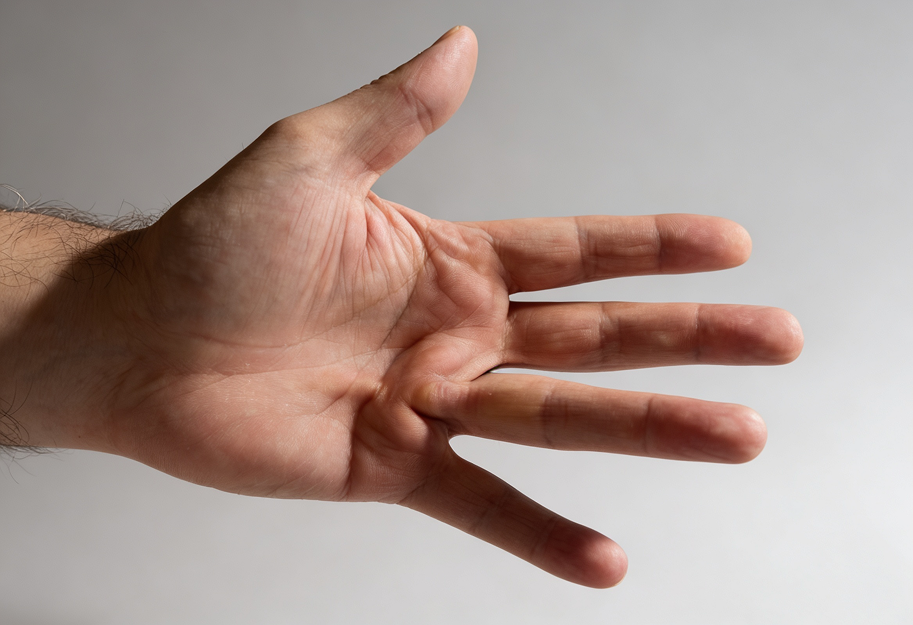
What is Dupuytren’s Disease?
Dupuytren’s disease (Dupuytren contracture) is a hand condition that affects the connective tissue beneath the skin of the palm.
Over time, this tissue, called the palmar fascia, thickens and tightens, forming:
- Small nodules (lumps)
- Thick cords under the skin
As the condition progresses, these cords pull one or more fingers (commonly the ring and little finger) into a bent position, making it difficult or impossible to straighten them fully.
Understanding the Condition
Dupuytren’s disease is not painful, but it can be functionally limiting.
It is considered a progressive fibrotic disorder, meaning:
- It develops gradually
- It worsens over time in many cases
- It affects hand mobility rather than causing acute inflammation
In some individuals (around 10%), the condition may stabilize or even regress, but most cases require monitoring or intervention.
What Causes Dupuytren’s Contracture?
The exact cause of Dupuytren’s disease is not fully understood. However, several risk factors are strongly associated with its development:
- Age above 40 years
- Male gender (men are significantly more affected)
- Family history or genetic predisposition
- Diabetes
- Smoking and alcohol consumption
- Northern European ancestry
It is important to note that while these factors increase risk, the condition can still occur without any clear cause.
Symptoms of Dupuytren’s Disease
Spotting wrist arthritis /symptoms early can make non-surgical treatments work better. Pain is the main sign, but other symptoms are also common:
- Stiffness, especially in the morning or after periods of inactivity, that takes 30 minutes or longer to ease
- Swelling and warmth over the back of the wrist or along the thumb side
- A grinding, clicking, or crunching sensation (crepitus) during wrist movement
- Visible deformity or changes in the contour of the wrist over time
- Loss of grip strength, objects slip from the hand unexpectedly
- Reduced range of motion, making it difficult to bend the wrist forward or backward fully
- Aching that worsens with activity and partially improves with rest in early stages, but becomes more constant as the condition advances
- Weakness that affects specific tasks like wringing, twisting, or pushing
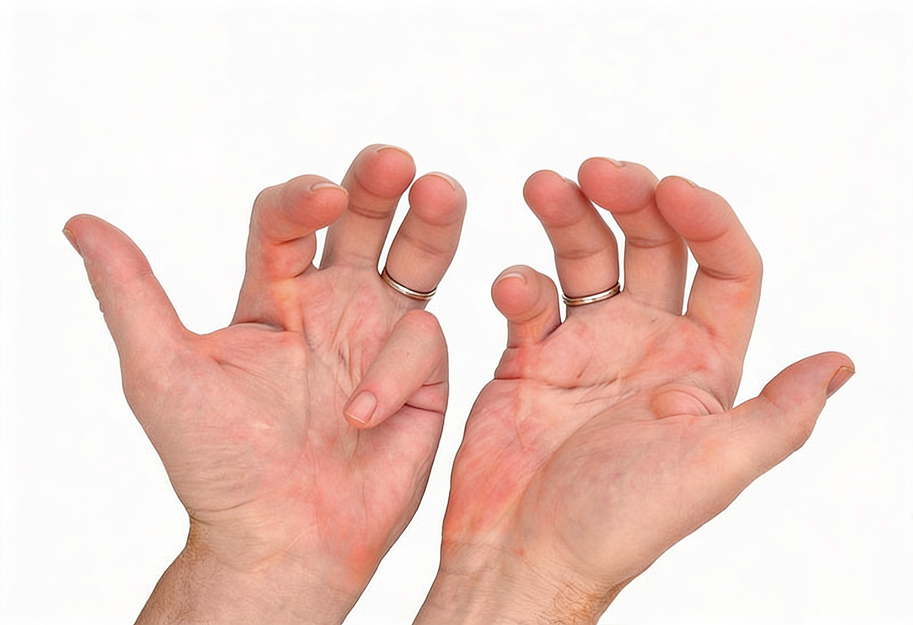
When should you seek treatment?
Early intervention can help slow progression and preserve hand function.
You should consider seeing a specialist if:
- You notice persistent lumps in your palm
- Your fingers begin to curl inward
- You cannot place your hand flat on a table
- Daily activities are becoming difficult
Dupuytren’s disease treatment in Dubai
Treatment is tailored based on:
- Severity of contracture
- Number of fingers involved
- Impact on daily life
A specialist like Dr. Ehab Bassim Aldlyami will recommend a suitable approach for your condition.
Non-surgical (conservative) treatment
If you have early-stage Dupuytren’s contracture, some non-surgical options may help you manage your symptoms:
- Hand therapy & stretching
- These exercises can help keep your fingers flexible
- They also help you maintain your range of motion
- Splinting or bracing
- Splints or braces can help keep your fingers in a better position
- In some cases, they may also slow down how quickly the condition gets worse
- Observation (“watchful waiting”)
- If your symptoms are mild, your doctor may just monitor your condition over time
Although these treatments usually do not reverse Dupuytren’s contracture, they can help slow down its progression.
Minimally invasive treatments
These are often recommended when contracture begins to affect function:
- Needle aponeurotomy
- A fine needle is used to break the cords
- Minimally invasive with quick recovery
- Collagenase injections
- Enzyme injections soften and dissolve the cords
- Followed by manual finger extension
These treatments offer faster recovery compared to surgery but may have a higher recurrence rate.
Surgical options for Dupuytren Contracture
For advanced cases, surgery may be the most advised solution.
Surgical options include:
- Fasciectomy
- Removal of the thickened tissue
- Provides long-lasting correction
- Dermofasciectomy
- Removal of affected tissue along with the overlying skin
- Skin graft may be required
- Lower recurrence in severe cases
Surgery is highly effective in restoring finger movement, though recovery may take several weeks to months.
Recovery
Taking care of your hand after treatment is important for getting your strength and movement back.
Here are some key steps to help your recovery:
- Do hand physiotherapy exercises
- Stretch your hand regularly
- Use a splint if your doctor recommends it
- Take care of any scars as directed
- Slowly get back to your usual daily activities
Following your specialist’s guidance ensures optimal results after Dupuytren’s contracture treatment in Dubai.
Can Dupuytren’s disease come back?
Yes, recurrence is possible even after treatment.
However:
- Early intervention reduces severity
- Advanced surgical techniques lower recurrence risk
- Ongoing hand care helps maintain results
Choose Dr. Ehab Bassim Aldlyami
When dealing with delicate hand conditions like Dupuytren’s disease, expertise matters.
Dr. Ehab Bassim Aldlyami is a Consultant Trauma and Orthopedic Surgeon with a specialized focus on:
- Hand and wrist surgery
- Complex connective tissue disorders
- Minimally invasive and surgical treatments
His approach focuses on:
- Accurate diagnosis
- Individualized care plans
- Restoring both function and quality of life
Take the first step towards better hand function
Dupuytren’s disease may start small, but it can significantly impact your daily life if left untreated.
With the right Dupuytren’s disease treatment in Dubai, you can:
- Improve hand mobility
- Reduce contracture
- Regain independence in daily tasks
Book a consultation with Dr. Ehab today and take control of your hand health.
FAQs
The best treatment depends on severity. Mild cases may only require monitoring, while advanced cases may need injections or surgery.
It is usually not painful, but it can cause discomfort and significant functional limitation over time.
There is no permanent cure, but treatments can effectively manage symptoms and improve hand function.
Surgery is recommended when finger bending interferes with daily activities or when the hand cannot be placed flat on a surface.
Recovery varies but takes several weeks, with physiotherapy playing a key role in regaining movement.
These are enzyme injections that break down the thickened cords, allowing the finger to straighten.
Yes, recurrence is possible, especially with non-surgical treatments, but proper care can reduce the risk.
Often yes, although one hand may be more severely affected than the other.
It can run in families, but not all cases are inherited.
If you notice finger bending, lumps in your palm, or difficulty using your hand, it’s time to consult a specialist.