

Dupuytren Contracture: Treatment & management
At a glance: Dupuytren Contracture: Treatment & management
|
Imagine trying to put your hand in your pocket, shake a friend’s hand, or place your palm flat on a table, but your ring finger or pinky gets stuck. If your fingers are gradually curling inward toward your palm, even simple tasks can become frustrating
That is where Dupuytren contracture: treatment & management should begin as early as possible to protect your hand’s mobility. This condition is not a problem with the muscles or tendons. Instead, it alters a thin layer of tissue right beneath your skin.
What is Dupuytren’s Contracture?
Dupuytren’s contracture is a hand condition where tissue under the skin of the palm slowly thickens and tightens. Over time, it pulls one or more fingers toward the palm, making it impossible to fully straighten them.
It is not painful for most people. But it can make everyday tasks, such as shaking hands, wearing gloves, typing, picking up objects, genuinely difficult.
Dupuytren’s Contracture causes and risk factors
The exact cause of Dupuytren contracture is still not fully understood, but genetics play a major role.
People with Northern European ancestry are more likely to develop the condition, which is why it is sometimes called “Viking disease.” It can also run strongly in families.
Other recognized risk factors include:
- Male sex (men are affected far more often than women)
- Age over 40
- Diabetes, epilepsy, and long-term alcohol use can increase risk
Recognizing the symptoms: How does the condition progress?
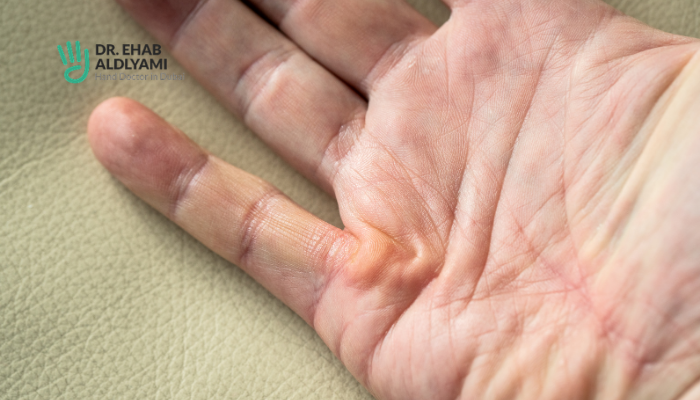
In the beginning, symptoms may seem minor. Some people mistake nodules (small, firm lumps) for calluses. Over time, the condition may worsen and affect daily function.
Common symptoms include:
- Thickened skin on the palm
- Small firm bumps beneath the skin (usually painless)
- Rope-like cords in the palm
- Difficulty straightening fingers
- Trouble shaking hands or wearing gloves
- Problems gripping large objects
The disease usually progresses slowly. Some people stay stable for years, while others experience faster tightening.
The stages of Dupuytren’s Contracture
Understanding the stages of Dupuytren’s contracture helps you and your surgeon choose the right approach at the right time.
Stage 1 Nodule Formation: A small, firm lump appears in the palm. The finger moves normally. No treatment is usually needed yet.
Stage 2 Cord Development: A fibrous cord becomes visible under the skin. The finger may slightly drift inward. Close monitoring begins.
Stage 3 Early Contracture: The finger bends noticeably. You may start losing the ability to fully open the hand. This is often when treatment becomes appropriate.
Stage 4 Fixed Contracture: The finger is pulled firmly toward the palm. Daily function is significantly affected. Surgical or procedural treatment is typically needed.
How is Dupuytren’s Contracture diagnosed?
Diagnosing this condition is straightforward. A hand and wrist specialist will look at your hand and feel your palm for nodules or cords.
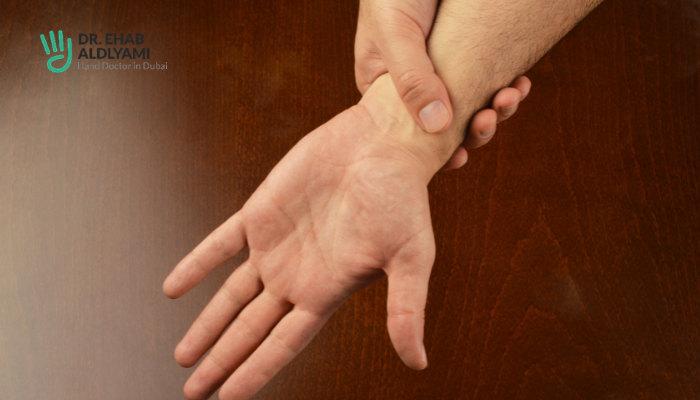
They will also ask you to try the “tabletop test.” You will try to place your hand completely flat on a flat surface. If you cannot get your palm and fingers to touch the table evenly, it is a clear sign that a contracture is developing. You rarely need X-rays or blood tests.
Early stage Dupuytren's Contracture treatment
For mild cases, watchful waiting is a completely valid choice. Not every nodule progresses rapidly. Your surgeon will monitor the condition at regular intervals.
When progression is clear or function is affected, several non-surgical and minimally invasive options exist:
- Needle aponeurotomy: A doctor numbs your hand and inserts a very fine needle through the skin to puncture and break up the tight cords of tissue.
- Enzyme injections: A specialized enzyme can be injected directly into the cord to soften and weaken the hardened tissue overnight. The next day, the doctor gently extends your finger to break the cord and straighten the digit.
Advanced Dupuytren Contracture: Treatment & management
When the finger is bent so far that you cannot use your hand properly, it is time for advanced Dupuytren contracture management. When non-surgical options fail or are not suitable, surgical intervention provides relief.
- Fasciectomy: This is the most common surgical procedure. A hand specialist makes an incision in the hand to remove the diseased tissue entirely. Removing the cord frees the finger to move normally again.
- Dermofasciectomy: In cases of recurrence or severe skin involvement, the overlying skin is also removed and replaced with a skin graft. This approach significantly lowers recurrence rates.
Why choose Dr. Ehab Aldlyami for Dupuytren's Contracture treatment in Dubai?
guidance. Dr. Ehab Aldlyami is known for his focused expertise in hand and wrist surgery, treating both early and advanced Dupuytren’s contracture cases.
His approach emphasizes:
- Accurate diagnosis
- Personalized treatment planning
- Modern minimally invasive techniques when appropriate
- Functional recovery, not just appearance
- Comprehensive aftercare and rehabilitation support
For patients in Dubai and the wider Middle East, access to specialized hand surgery care can make a meaningful difference in long-term hand function and comfort.