

Types of Wrist Injuries and Symptoms
Can a wrist injury heal on its own, or does that nagging ache point to something more? A fall from a scooter, a long day at the keyboard, or a tough game of padel can all leave your wrist sore. It is tempting to wrap it up and wait. Sometimes, that is enough. But wrist injuries from falling can also involve a fracture or ligament damage that may worsen if ignored.
This guide covers the main wrist injury types, what each one feels like, and when to get help. It reflects the care approach of Dr. Ehab Aldlyami, a UK-trained hand and wrist surgeon at King’s College Hospital Dubai Hills, who puts non-surgical care first.
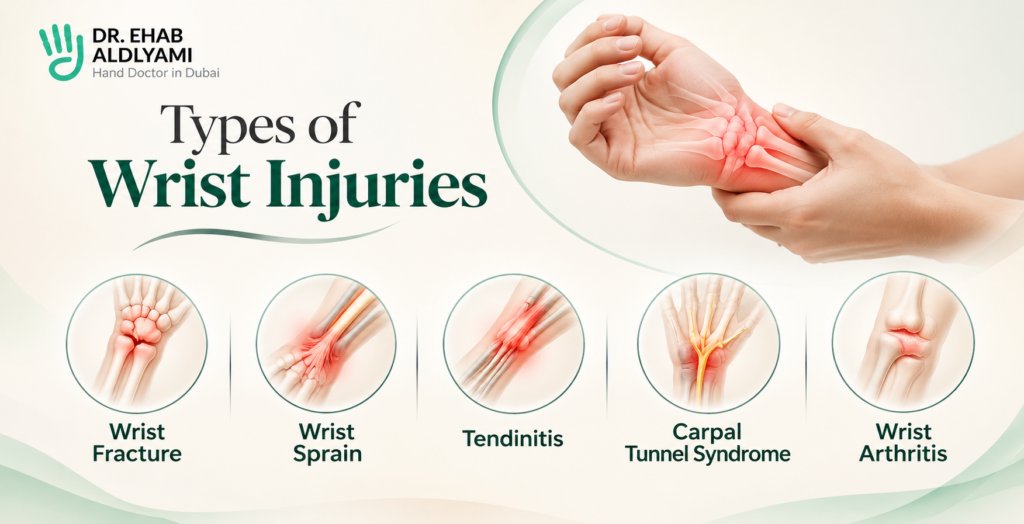
What are 4 common wrist injuries?
The wrist contains multiple small bones, ligaments, tendons, and other structures that work together to provide strength and movement. This complexity means that different injuries can sometimes cause similar symptoms.
Here are four important wrist injury types to know about.
- Fractures: breaks in the forearm bone near the wrist (distal radius) or in a small wrist bone such as the scaphoid
- Sprains and ligament injuries: stretched or torn ligaments, including the scapholunate ligament
- Tendon injuries: irritation or inflammation of the tendons that move the wrist and thumb
- TFCC tears: damage to the cartilage cushion on the little-finger side of the wrist
Nerve compression, such as carpal tunnel syndrome, often joins this list and can mimic an injury.
Wrist injury types by how they happen
The story behind your pain is the best clue. Find yours below.
1.Wrist injuries from falling: Fractures and ligament tears
The reflex that protects your face can cost you your wrist.
Landing on an outstretched hand is the classic cause of a distal radius fracture. The same force can injure ligaments and smaller bones. Slips, cycling or e-scooter spills, and sports tackles are common triggers.
- Distal radius fracture: sudden pain, swelling, bruising, and sometimes a visible bend near the wrist
- Scaphoid fracture: deep pain at the base of the thumb, tenderness in the small hollow there (the “anatomical snuffbox”), and a weak grip. It is easily mistaken for a sprain.
- Scapholunate ligament injury: an ache in the center of the wrist, clicking, and weakness when you put weight through the hand
Pain that lingers a few days after a fall deserves imaging, even if the wrist looks normal.
2. Twisting and pushing: TFCC tears
- Pain on the little-finger side of the wrist
- Sharper pain when you rotate the forearm, push up from a chair, swing a racket, or lift weights
- Clicking, catching, or a feeling that the wrist is unstable
- Can follow a fall or build gradually from repeated strain
3. Overuse and wrist injury tendon problems
Tendon trouble tends to creep in rather than strike.
De Quervain’s tenosynovitis is a common example.
- Pain and swelling along the thumb side of the wrist
- Pain that worsens with gripping, pinching, or lifting
- Often linked to repetitive tasks such as frequent phone use or lifting a baby
- Often eases with early rest, splinting, and hand therapy
4. Tingling and numbness: Nerve compression
- Numbness or pins and needles in the thumb, index, and middle fingers
- Symptoms that wake you at night
- Dropping things or a weaker grip
- Often caused by pressure on the median nerve, known as carpal tunnel syndrome
Wrist injury symptoms: What could they mean?
Not all wrist pain points to the same problem. The location of pain, how the injury occurred, and which movements make it worse can provide useful clues.
Symptom or situation | What it may indicate |
Pain immediately after a fall | Sprain or fracture |
Significant swelling or deformity | Possible fracture |
Pain on the little-finger side | TFCC or another ulnar-sided problem |
Pain with repetitive movement | Tendon irritation or overuse |
Clicking or catching | Ligament or TFCC injury |
Weak grip | Tendon, ligament, or structural injury |
Numbness or tingling | Possible nerve involvement |
These patterns are not a diagnosis. Several conditions can produce overlapping wrist injury symptoms, so an examination may be needed to identify the affected structure.
Can a wrist injury heal on its own?
Sometimes. It depends on what’s injured.
Often settle with rest, a splint, and anti-inflammatory medication:
- Mild sprains
- Early irritation, such as a mild wrist injury tendon strain
Rarely heal correctly without proper care:
- Scaphoid fractures and displaced fractures
- Torn ligaments
- Unstable TFCC tears
A wrist that looks fine can still heal out of position. A checkup is a small price compared with long-term stiffness.
Wrist injury treatment: What are your options?
The right wrist injury treatment depends on the injury, its severity, the structures involved, and your functional needs.
Treatment may include:
- Accurate diagnosis first: a detailed exam plus imaging, so subtle injuries aren’t missed
- Non-surgical options: splints or casts, rest, anti-inflammatory medication, injections in selected cases, and guided hand therapy
- When surgery is needed: fixing displaced fractures, repairing ligaments, minimally invasive (arthroscopic) procedures, or releasing a compressed nerve
- A shared decision: you’re informed and involved at every step
When should you see a wrist specialist?
Not every wrist injury needs urgent treatment. However, certain wrist injury symptoms should not be ignored, especially after a fall, accident, or sports injury.
Consider seeing a wrist specialist if you have:
- Severe or worsening pain
- Significant swelling or bruising
- A visibly deformed wrist
- Difficulty moving your wrist or hand
- Persistent weakness or reduced grip
- Numbness or tingling
- Pain that does not improve with rest
- Ongoing symptoms after a fall or sports injury
Early assessment can help distinguish between different wrist injury types and identify the appropriate treatment before the problem affects everyday hand function.
Don't guess with your wrist: Get clear answers from a Dubai hand specialist
Dr. Ehab Aldlyami brings more than 25 years of specialized hand and wrist experience, with UK training in trauma and orthopedics and specialist hand fellowship training at the Pulvertaft Hand Centre. His practice covers complex hand and wrist trauma, fractures, tendon injuries, wrist arthroscopy, TFCC injuries, and other wrist conditions.
Wrist pain rarely announces what’s behind it. A proper diagnosis protects your grip, your movement, and your return to the things you love, and in many cases it means avoiding surgery altogether.
Ready to get your wrist checked? Book your appointment with Dr. Ehab Aldlyami today.
FAQs
The four most prevalent are fractures, sprains and ligament injuries, tendon injuries, and injuries to the TFCC (tarsal tunnel fibromeniscus). For fractures particularly of the scaphoid or significant ligament injuries require prompt imaging. If pain persists for more than a week or two, tendon strains and TFCC problems should be evaluated.
Often you can’t, because a small fracture can feel like a mild sprain. Sharp pain, rapid swelling, bruising, or a visible bend suggest a fracture. If you can’t grip or bear weight, or pain isn’t improving in a few days, get an X-ray.
Yes. The first X-ray after a fall may not reveal a crack. When there is continued pain in the thumb base, imaging is performed again or an MRI or a CT scan may be ordered. Early diagnosis matters because an untreated scaphoid fracture can heal poorly.
It begins with a detailed examination and imaging. Dr. Ehab first treats non-surgically including splints, rest, medication, selected injections and hand therapy, when safe. Surgery is only recommended if an injury is severe or if conservative steps fail.
Not necessarily. Many sprains, tendon problems, and stable fractures improve with a splint or cast, medication, and hand therapy. Surgery is more likely when bones are displaced, a ligament is fully torn, or the wrist is unstable. Your surgeon will go over your options after examining you.