

Broken or Sprained Wrist? Signs, Symptoms & Treatment
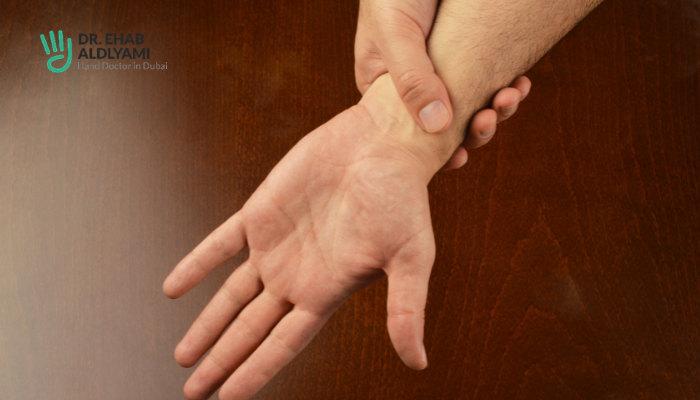
A fall in the gym, a hard tackle on the football pitch, a slip on a wet floor, and suddenly your wrist is swollen, aching, and hard to move. The first question almost everyone asks next is the same: Is my wrist broken or sprained?
It’s a harder question to answer than it sounds. Both injuries can look and feel nearly identical in the first 24 hours, the wrong assumption can delay appropriate treatment, particularly when a fracture is subtle and initially mistaken for a sprain.
This guide walks through exactly how to know if your wrist is sprained or broken, what causes each injury, and what recovery realistically looks like, with insight from Dr. Ehab Bassim Aldlyami, a UK-trained Consultant Hand and Wrist Surgeon, whose practice focuses exclusively on hand and wrist conditions rather than orthopedics in general.
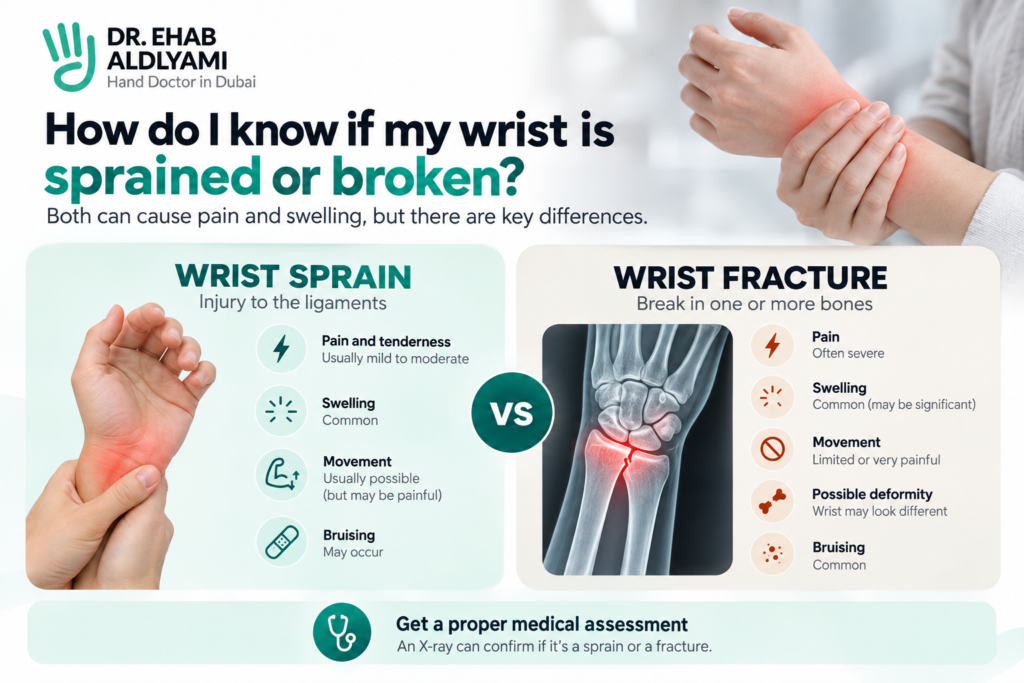
How do I know if my wrist is sprained or broken?
This is the single most common question patients ask after a wrist injury, and for good reason, a sprain and a fracture can share nearly every early symptom: swelling, bruising, and pain on movement.
A few signs tend to point more clearly toward one or the other:
More likely a sprain:
|
More likely a break:
|
A sprain occurs when one or more wrist ligaments are stretched or torn. A fracture, on the other hand, occurs when a wrist bone cracks or breaks.
The severity of the accident does not always tell you which injury you have. Seemingly, a minor fall can cause a fracture, while a more dramatic injury may result primarily in ligament damage.
If you’re still unsure how to know if your wrist is sprained or broken after checking this list, that uncertainty alone is a reason to get it examined rather than waiting it out.
Symptom of broken wrist vs sprained wrist: What should you look for?
When comparing the symptom of broken wrist vs sprained wrist, there is considerable overlap. Neither injury follows exactly the same pattern in every person.
Symptom | Wrist Sprain | Wrist Fracture |
Pain | Often worse with movement | May be significant, especially over the injured bone |
Swelling | Common | Common |
Bruising | Possible | Possible |
Tenderness | Often around the injured soft tissues | May be localized over the fracture |
Movement | May be painful or restricted | May be painful or restricted |
Deformity | Uncommon | May occur with displaced fractures |
A visible deformity is an important warning sign, but the absence of deformity does not rule out a fracture. Some wrist fractures are small, stable, or difficult to see without imaging.
Similarly, being able to move your wrist does not automatically mean that it is only sprained.
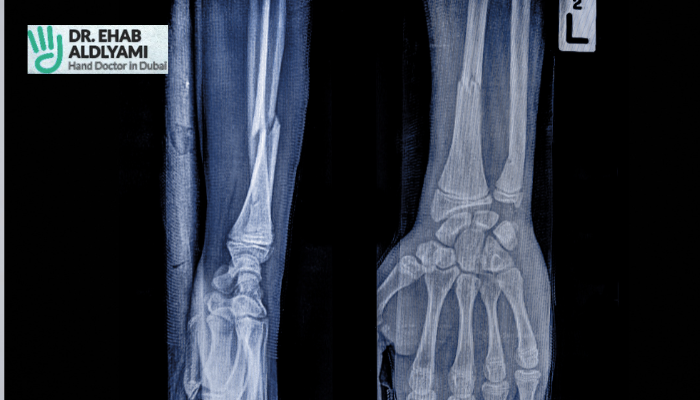
A fractured scaphoid, the small bone at the base of the thumb, can easily be mistaken for a mild wrist sprain. The scaphoid is the most commonly fractured carpal bone and may not be clearly visible on an initial X-ray. Parts of the scaphoid have a relatively limited blood supply, which can make some fractures slower to heal and increase the risk of non-union if they are missed.
What causes a sprained wrist and broken wrist?
Sprained wrist and broken wrist causes overlap significantly, which is exactly why the two get confused so often:
- Falls onto an outstretched hand (FOOSH) – the leading cause of both sprains and fractures, whether from a stumble, a bike fall, or a slip
- Sports injuries – racquet sports, football, padel, and wrist-loaded gym movements like planks, push-ups, and weightlifting
- Road traffic accidents – higher-impact trauma more often results in a fracture
- Repetitive strain – overuse and repeated stress can sprain ligaments without any single traumatic event
- Direct blows – a hard knock to the wrist during contact sports or an accident
As a general pattern, high-impact trauma is more likely to cause a fracture, while a twisting motion without direct force more often results in a sprain, though this is only a guide, not a diagnosis.
Why the right diagnosis matters more than the first X-ray?
An X-ray is usually the starting point, but it isn’t always the final word. When a fracture is suspected clinically despite a clear initial X-ray, tenderness specifically at the base of the thumb, or pain that isn’t improving as expected, if clinical suspicion remains despite an initially normal X-ray, a specialist may recommend repeat imaging or further assessment with CT or MRI, depending on the suspected injury.”
This kind of careful, targeted follow-up is standard practice at a dedicated hand and wrist clinic, where a specialist hand and wrist assessment can be particularly valuable when symptoms and initial imaging do not tell the whole story.
Treatment for a sprained or broken wrist
Treatment depends on what has actually been injured, not simply how painful the wrist feels.
Treatment for a sprained wrist
Milder sprains may improve with conservative care, such as:
- Rest and activity modifications.
- Temporary splinting
- Pain management (if applicable)
- A gradual return to movement.
- Hand therapy or rehabilitation for more severe injuries
More serious ligament injuries may need more careful observation and in a few special cases, surgical intervention.
Treatment for a broken wrist
A fracture may be managed with:
- A splint or cast
- Immobilization
- Follow-up imaging
- When needed, reduction will be performed to realign the bones.
- Surgical repair for limited displaced, unstable and complex fractures.
- Following surgery, hand therapy is an important part of recovery.
Dr. Ehab’s treatment philosophy is non-surgical first, which means he will consider the appropriate conservative treatment options before surgery is an option. Surgery is sometimes the only treatment if the fracture is unstable, significantly dislocated, or if the fracture is not expected to heal without surgery.
Sprained wrist and broken wrist recovery time
The recovery time for a sprained or broken wrist will vary from person to person. The healing will depend on the severity of the injury, its location, the treatment required and the contribution of movement and strength in the rehabilitation process.
- Mild sprain: 1–2 weeks of rest, ice, and support
- Moderate to severe sprain: 4–8 weeks, sometimes with a period of splinting
- Simple, non-displaced fracture: around 6–8 weeks in a cast, with most patients regaining good function within 3 months
- Displaced or complex fracture (including scaphoid fractures needing surgery): 3–6 months for full recovery, and longer if the diagnosis was delayed
The gap between sprained and broken wrist recovery times widens considerably when a fracture goes unnoticed early on, another reason an accurate diagnosis on day one matters more than it might seem.
When should you see a hand and wrist specialist?
If you are still asking “Is my wrist broken or sprained?” several days after an injury, don’t rely solely on symptoms to make the decision.
A specialist assessment is particularly important when:
- Pain remains significant
- Swelling is not improving
- You have persistent tenderness in one specific area
- Wrist movement remains restricted
- You have difficulty gripping objects
- Numbness or tingling develops
- You were initially told it was a sprain, but symptoms continue
- You want to return to demanding work or sports safely
A careful examination can help distinguish a straightforward sprain from a fracture, ligament injury, or another wrist condition requiring specific treatment.
Why do patients in Dubai choose Dr. Ehab Aldlyami?
Dr. Ehab Bassim Aldlyami is a Consultant Hand and Wrist Surgeon at King’s College Hospital London, Dubai, with over two decades of experience treating hand and wrist injuries exclusively. His background includes:
- Fellowship of the Royal College of Surgeons (UK) in Trauma and Orthopedics
- A Pulvertaft Clinical Hand Fellowship from Royal Derby University Hospital, UK, one of the most respected hand surgery training programs in the world
- Vice President of the Emirates Hand Surgery Society
- A practice focused specifically on hand and wrist conditions, including the scaphoid fractures that general orthopedic assessments most often overlook
That focus matters. A wrist injury assessed by a specialist who works exclusively on hands and wrists is far less likely to be misread as a simple sprain when something more serious is going on.
Don't let a wrist injury become a long-term problem
Whether you are dealing with a suspected sprain, fracture, or persistent wrist pain after an injury, getting the diagnosis right is the first step toward the right treatment.
If you’re unsure whether your wrist is broken or sprained, book a consultation with Dr. Ehab Bassim Aldlyami for specialist hand and wrist assessment in Dubai.
FAQs
Being able to move your wrist does not rule out a fracture. A sprain will usually result in more diffuse swelling and pain, whereas a fracture will produce localized, more severe pain. Persistent swelling or pain should be assessed rather than assumed to be a sprain.
Without imaging, you don’t know. Symptoms such as deformity, pinpoint tenderness, grinding or increasing pain may indicate a fracture. If symptoms persist, get the wrist examined.
A mild sprain can take 1-2 weeks to heal, and a severe sprain can take several weeks. Simple fractures can take 6-8 weeks, while more complex fractures may require more time.
Falls onto an outstretched hand are common causes, along with sports injuries, road accidents, direct blows, and twisting injuries.
Some minor fractures may heal with proper support, but a fracture should be diagnosed first. Missed fractures, especially scaphoid fractures, can fail to heal and may require more complex treatment.
Yes. Movement does not rule out a fracture. If you have ongoing pain, swelling, or localised tenderness after an injury, get your wrist assessed.