

Pain in Fingertips: 10 Causes and When to See a Hand Specialist
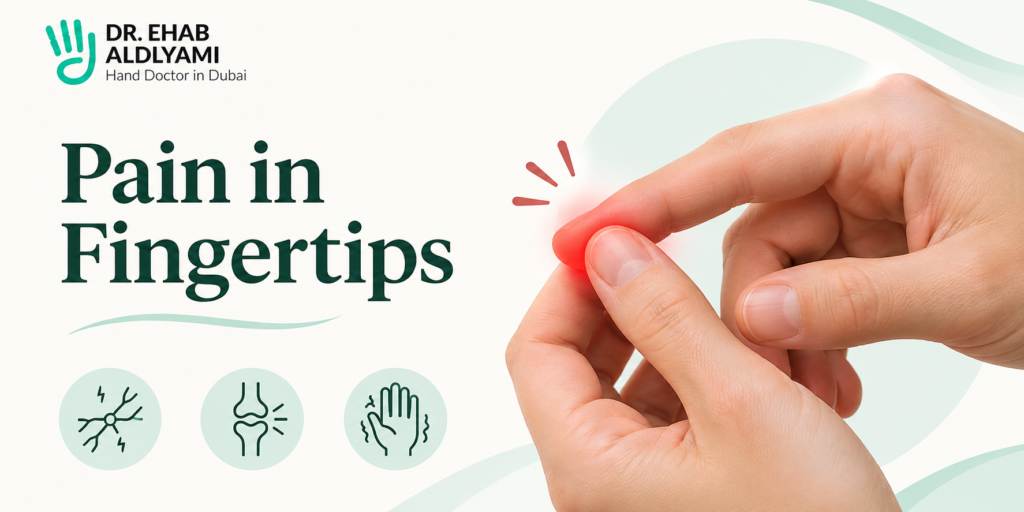
Do you feel a sudden jolt when you press your fingertip? Does it keep returning, leaving you wondering whether something more serious is going on? Pain in fingertips can stem from a harmless bruise or from a condition that needs proper care, and pain in tip of finger when pressed is often the first sign people notice. Dr. Ehab Aldlyami, a consultant orthopedic hand and wrist surgeon in Dubai, treats these concerns.
Below are ten common causes, so you can tell what may settle on its own from what deserves an opinion from a hand specialist, Dr. Ehab Aldlyami.
Why do you feel pain in your fingertips?
It could be because of these reasons:
- Fingertips hold dense nerve endings, so even small problems feel intense.
- The source may be local (skin, nail, bone), in tendons and joints, or a nerve pinched at the wrist or elbow.
What are the 10 causes of pain in your hand and finger tips?
- Jammed or sprained finger: A knock can stretch the ligaments, the tough bands that steady a joint. Expect swelling, bruising, and pain in tip of finger when pressed. A crooked or immovable finger needs prompt checking.
- Mallet finger: This happens when the tendon that straightens the fingertip tears or pulls away from the bone. The tip droops and cannot straighten on its own, so it is important to use a splint early.
- Fractured finger: A crush or fall can break the small bones in the finger. Pain, swelling, and tenderness over the bone are common. An X-ray is needed to confirm the break.
- Trigger finger: When the tendon sheath thickens, the finger can catch or lock as it bends. There is often a tender lump in the palm, and symptoms of trigger finger are usually worse in the morning.
- Osteoarthritis: Over time, the cartilage in the joint near the fingertip wears down. This can make the joint stiff, achy, and bumpy, and pressing on it may cause soreness.
- Ganglion cyst: This is a fluid-filled lump that grows from a joint or tendon sheath. If it is near the fingertip, it can press on the nail and feel tender. Most ganglion cysts are harmless.
- Carpal tunnel syndrome: Compression of the median nerve at the wrist may cause tingling, numbness, or burning in the thumb, index, and middle fingertips. Carpal tunnel syndrome symptoms often occur at night.
- Cubital tunnel syndrome: Irritation of the ulnar nerve at the elbow may cause tingling in the ring and little fingers and can sometimes weaken grip strength.
- Paronychia: This infection near the nail, often resulting from nail biting or manicures, causes redness, swelling, tenderness, and may produce throbbing or sharp fingertip pain.
- Felon: An infection in the fleshy pad of the fingertip. Tense, intensely throbbing swelling develops and needs prompt medical attention.
Patient Tip: Note what triggers your pain and photograph any swelling or redness. These details help your specialist find the cause faster. |
Symptoms of the pain are listed below:
Cause Group | Typical Feeling | Common Clue |
Injury | Aching, tender when pressed | A recent jam, knock, or fall |
Tendon and joint | Stiffness, catching, tenderness | Worse in the morning or when gripping |
Nerve | Tingling, numbness, burning | Night-time symptoms or dropped objects |
Skin and nail | Throbbing, warmth, swelling | Redness around the nail |
How can a Hand Specialist help?
A hand specialist is an orthopedic surgeon trained in hand and wrist care. They will deeply examine you for conditions like a sharp stabbing pain in finger tip. They examine the finger, hand, and arm, order tests such as an X-ray if needed, and start with the simplest helpful option.
Important to Know: Fever, spreading redness, a tense swollen fingertip, a bent finger, or sudden numbness after injury needs prompt assessment. |
When should you see a Hand Specialist for pain in fingertips?
- Persistent pain: pain that doesn’t go away with rest and/or comes back.
- Stiffness or weak grip: trouble moving the finger or dropping things.
- Urgent signs: deformity, uncontrolled swelling, spreading redness, fever or sudden numbness.
Patients often ask, ‘What type of doctor should I see for finger pain?’ The family doctor is the obvious first port of call; a hand specialist is the one you’d go to if you’ve got ongoing pain, pain that comes back or pain following an injury.
What is the best treatment approach for pain in the fingertips?
Non-surgical treatments
- Hand therapy and rest: protect the area and restore movement.
- Splinting: holds the finger or wrist in a useful position.
- Medication: helps to reduce the swelling and discomfort.
- Steroid injection: calms the inflammation (as in trigger finger or carpal tunnel).
Surgical procedures
- Trigger finger release: a small incision is used to free the tight tendon sheath.
- Carpal tunnel release: (either open or endoscopic) to relieve the pressure on the nerve. Open surgery involves a small cut in the palm; endoscopic involves a few smaller incisions and the use of a tiny camera. Which of the two is appropriate for you will be discussed with your surgeon.
- Small joint replacement: an option for painful finger arthritis. Worn joint surfaces are replaced with new ones, which can ease movement. It usually comes up only after gentler measures have been tried.
- Ganglion and lump treatment: for troublesome lumps of the hand and wrist. The lump is examined first to determine what it is. Treatment is discussed if it hurts, grows, or interferes with hand use.
How do you go about finding the right hand specialist in your area?
A few checks can help you choose a surgeon you feel confident in:
- Look for recognized qualifications and hand-specific training.
- Choose someone who will lay out the options in a straightforward way and will consider non-surgical treatment as the first option.
- Ask if hand and wrist conditions form a regular part of their practice.
- Just make sure you’re comfortable asking questions and that the follow-up care is clearly explained.
Find the exact cause of your fingertip pain
Get in touch with the specialist - Dr. Ehab Aldyami
Living with pain in the fingertips, or pain at the tip of a finger when pressed that keeps returning, is not something to simply put up with. Dr. Ehab Aldlyami is a British board-certified consultant orthopedic surgeon who completed the Pulvertaft Hand Fellowship in the UK, holds the European Diploma of Hand Surgery, and practices at King’s College Hospital Dubai Hills.
If symptoms are lasting or worrying you, consider booking a consultation to understand what is happening.
FAQs
Pressure-triggered tenderness is usually indicative of something local (a bruise, a small cyst, an infection adjacent to the nail, a minor bone or ligament injury, etc.). The fingertips are full of nerve endings, so even a minor problem will feel quite sharp. If the tenderness is persistent, getting worse or follows an injury, then a hand specialist will be able to work out what the problem is.
Yes. A nerve being pinched at the wrist or elbow (as in carpal tunnel or cubital tunnel syndrome) can produce tingling, numbness, or a burning sensation in the fingertips, even though the problem is actually in the wrist or elbow. That’s why a specialist will assess the whole arm, not just the troublesome finger, before deciding on the appropriate treatment.
No. A great many cases will follow a minor knock or a strain and will settle with rest and protection. If the pain is persistent, keeps coming back, is associated with numbness, swelling or redness or is limiting in any way, then it should not be ignored. An early assessment will often make treatment much easier, so if in any doubt, it is sensible to get an expert’s view.
Causes include injury, tendon and joint problems (trigger finger, pinched nerve at the wrist or elbow, etc.), and nail infections. Some conditions produce similar symptoms, making it difficult to identify the exact cause without an examination. Pain may also be accompanied by numbness, swelling, stiffness, tingling, or reduced grip strength. A number of these are very similar, so a hand specialist’s assessment is essential.
Often not. Many conditions are first managed with rest, splints, hand therapy, medication, or an injection. Surgery is generally considered when these measures do not help, or when the problem, such as a displaced fracture or nerve compression, calls for it. Your specialist will explain which options suit your situation.