
What is the Most Common Hand Surgery
Your hands are involved in almost everything you do, from typing an email to holding a cup of coffee. So when pain, numbness, or stiffness starts getting in the way, it affects far more than one part of your body.
For many people, nonsurgical care such as splints, therapy, or injections brings relief. When it doesn’t, surgery may become part of the conversation.
If you’re exploring your options, you may be wondering what is the most common hand surgery, what it involves, and how soon you can return to daily life.
Read to know the most frequently performed procedures, what to expect, typical recovery timelines, and the risks worth discussing with your surgeon.
Quick fact |
What is the most common hand surgery?
Carpal tunnel release is widely reported as the most common hand surgery in the United States, with hundreds of thousands of procedures performed each year.
The carpal tunnel is a narrow passage on the palm side of your wrist. When tissues around it swell or thicken, they press on the median nerve, which can cause:
- Numbness or tingling in the thumb, index, middle, and part of the ring finger
- Symptoms that often get worse at night
- Weakness or clumsiness when gripping
- Dropping things more often than usual
During carpal tunnel release, the surgeon cuts the transverse carpal ligament, the band of tissue forming the roof of the tunnel. This creates more space and relieves pressure on the nerve. It can be done as open surgery through a small incision in the palm or endoscopically using a tiny camera.
Surgery is considered when symptoms persist despite splinting and other conservative treatments, or when there are signs of ongoing nerve compression, such as constant numbness or weakness at the base of the thumb.
Other types of hand surgery you should know about
Carpal tunnel release is just one of many procedures within orthopedic hand surgery. Other common types of hand surgery include:
- Trigger finger release: Frees a tendon that catches or locks when you bend your finger.
- Ganglion cyst removal: Removes a fluid-filled lump on the wrist or hand that causes pain or limits movement.
- Dupuytren’s contracture treatment: Releases thickened tissue in the palm that pulls fingers into a bent position.
- Fracture fixation: Deploys plates, screws, or pins to stabilize broken bones, such as a distal radius fracture.
- Tendon and nerve repair: Restores function after injuries to the structures controlling movement and sensation.
- De Quervain’s release: Relieves painful tendon irritation on the thumb side of the wrist.
- Arthritis surgery: Includes joint fusion or joint replacement, often at the base of the thumb.
- Wrist arthroscopy: A minimally invasive technique to diagnose and treat certain wrist problems through small incisions.
The right procedure depends on your diagnosis, symptoms, lifestyle, and overall health.
Hand surgery how long does it take?
Patients often ask, “Hand surgery how long does it take?” The answer depends on the procedure and its complexity. As a general guide:
- Carpal tunnel release: 15-30 minutes
- Ganglion cyst removal: 20-45 minutes
- Trigger finger release: 10-20 minutes
- Fracture fixation: 1-2 hours
- Tendon repair or complex reconstruction: 1-3 hours
Many hand procedures are performed as day surgery, so you may be able to go home the same day. Anesthesia may be local, regional (numbing the whole arm), or general, depending on the procedure.
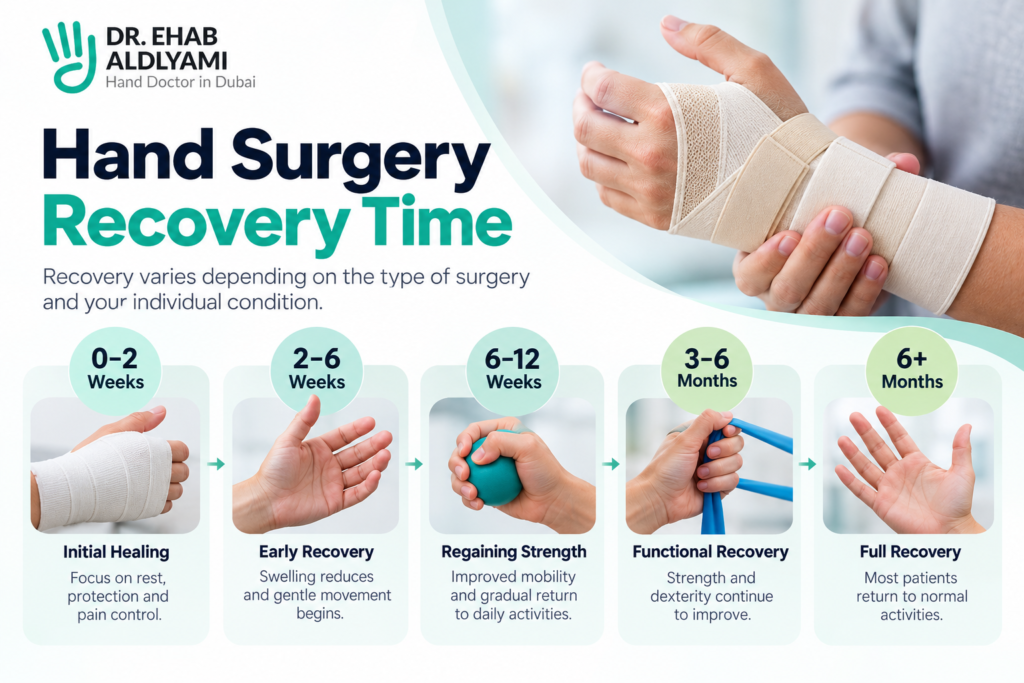
What is hand surgery recovery time like?
Hand surgery recovery time varies from person to person. The type of surgery, your age, general health, and how closely you follow aftercare instructions all play a role.
Here is a broad look at what to expect:
- Carpal tunnel release: Light hand use is often possible within a few days, and stitches are usually removed after 10 to 14 days. Grip strength may take several weeks to a few months to return.
- Trigger finger release: Many people resume everyday activities within a few weeks.
- Fracture fixation: Bone healing commonly takes 6 to 12 weeks, with strength improving over the following months.
- Ganglion cyst removal: Recovery generally takes around 2 to 6 weeks.
- Tendon repair: Recovery may take three months or more and usually requires structured hand therapy.
Tips for a smoother recovery:
- Keep your hand elevated in the first few days to reduce swelling
- Keep the dressing clean and dry
- Move your fingers gently as advised by your surgeon
- Attend all follow-up and hand therapy appointments
- Avoid heavy lifting until you are cleared to do so
Understanding the risks
Like all surgical procedures, hand surgery carries some risks. These may include infection, bleeding, stiffness, scar tenderness, nerve or blood vessel injury, and a reaction to anesthesia.
In certain cases, symptoms may not fully resolve or may return over time. For example, people with long-standing, severe carpal tunnel syndrome may still have some numbness after surgery.
Your surgeon should explain the specific risks and expected outcomes for your condition before you decide on treatment.
Also Read: Common Scaphoid Fracture Complications
When should you see an orthopedic hand surgery specialist?
Consider booking a consultation if you notice:
- Numbness or tingling in your fingers that keeps coming back
- A finger that clicks, catches, or locks
- A painful or growing lump on your hand or wrist
- Pain, swelling, or reduced movement after an injury
- Stiffness that makes daily tasks harder
An early assessment with an orthopedic hand surgery specialist can help you understand whether nonsurgical treatment or surgery is the more suitable option for you.
Hand surgery in Dubai with a British board-certified hand surgeon
If you are considering hand surgery in Dubai, Dr. Ehab Bassim Aldlyami, Consultant Orthopedic Surgeon at King’s College Hospital London, Dubai, brings over 25 years of experience in hand and wrist surgery.
He completed his specialist training in Trauma and Orthopedics through the Royal College of Surgeons in the UK, trained at the Pulvertaft Hand Centre at the Royal Derby Hospital, and holds a European Diploma of Hand Surgery. He also serves as Vice President of the Emirates Society of Hand Surgeons.
Dr. Ehab treats a wide range of conditions, from carpal tunnel syndrome and tendon injuries to complex hand and wrist fractures, with a focus on personalized, evidence-based care.
Book your consultation with Dr. Ehab today and take the first step toward more comfortable, capable hands.
FAQs
Hand surgery is performed under local, regional, or general anesthesia, so you should not feel pain during the procedure. Some soreness, swelling, or tenderness is common afterward and is usually managed with prescribed or over-the-counter pain relief. Discomfort eases over the first few days to weeks.
In mild to moderate cases, symptoms may improve with nonsurgical options such as wrist splints worn at night, activity changes, hand therapy, or steroid injections. Surgery is usually considered when symptoms persist despite these treatments or when there are signs of ongoing nerve compression.
It depends on the procedure. Simpler surgeries, such as trigger finger release, may only need home exercises. Tendon repairs, fracture fixation, and complex reconstructions often require a structured therapy program to help restore movement and strength.
After operations such as carpal tunnel release, a large number of people who have desk jobs come back to work within one or two weeks. However, jobs that involve heavy lifting, gripping or repetitive hand movements may require several weeks or longer. The surgeon will give you advice according to the operation and your recovery process.
You should only drive once you can grip and control the steering wheel comfortably and safely, and are no longer taking medication that causes drowsiness. The timing varies, so check with your surgeon before getting back behind the wheel.
Most hand procedures leave a small scar. It may feel tender or firm at first and usually softens and fades over several months. Endoscopic and minimally invasive techniques may involve smaller incisions.